Sometimes communication breaks down even when everyone speaks English well. At NextTier, we want to understand why. Grammar, pronunciation and vocabulary matter, of course—but communicating successfully also means understanding how our choices come across to other people. In this article, we look at one way of thinking about that: Richard D. Lewis’s model of cross-cultural communication.
We recognise that people communicate in different ways. Our aim is to understand each client’s communication needs and tailor our assessment and recommendations accordingly.
In a recent conversation, NextTier co-founders Leigh Harris and Phil Stam reflected on how communication can be affected by expectations that go beyond language. Leigh has lived and worked in England, Portugal, Spain, Brazil, Senegal, Thailand, Romania, Myanmar, Cambodia and the Philippines. Phil has lived and worked in England, Sweden, China, the Netherlands, the Philippines and Greece. Between them, they have experienced communication across a wide range of cultural settings.
Cultural differences in business meetings
Many cultural differences in business meetings come from expectations, not language: how a meeting should run, when to disagree, or how directly to express an opinion.
For example, one person may expect a clear agenda, decisions in order and a firm finish time. Another may prefer to let the conversation develop, build relationships as they go and adjust the plan when new ideas emerge. Someone else may listen carefully but avoid disagreeing openly, especially in front of a group.
Each person may leave the meeting with a different impression. One thinks the discussion was unfocused. Another feels the group was too rigid. A third is unsure whether their concerns were understood.
Linear-active, multi-active and reactive: the three communication styles
Richard D. Lewis’s model of cross-cultural communication, often called the Lewis model, offers one way to think about such differences. It describes three broad patterns: Linear-active, Multi-active and Reactive. These can help us reflect on different approaches to planning, conversation, listening and disagreement.
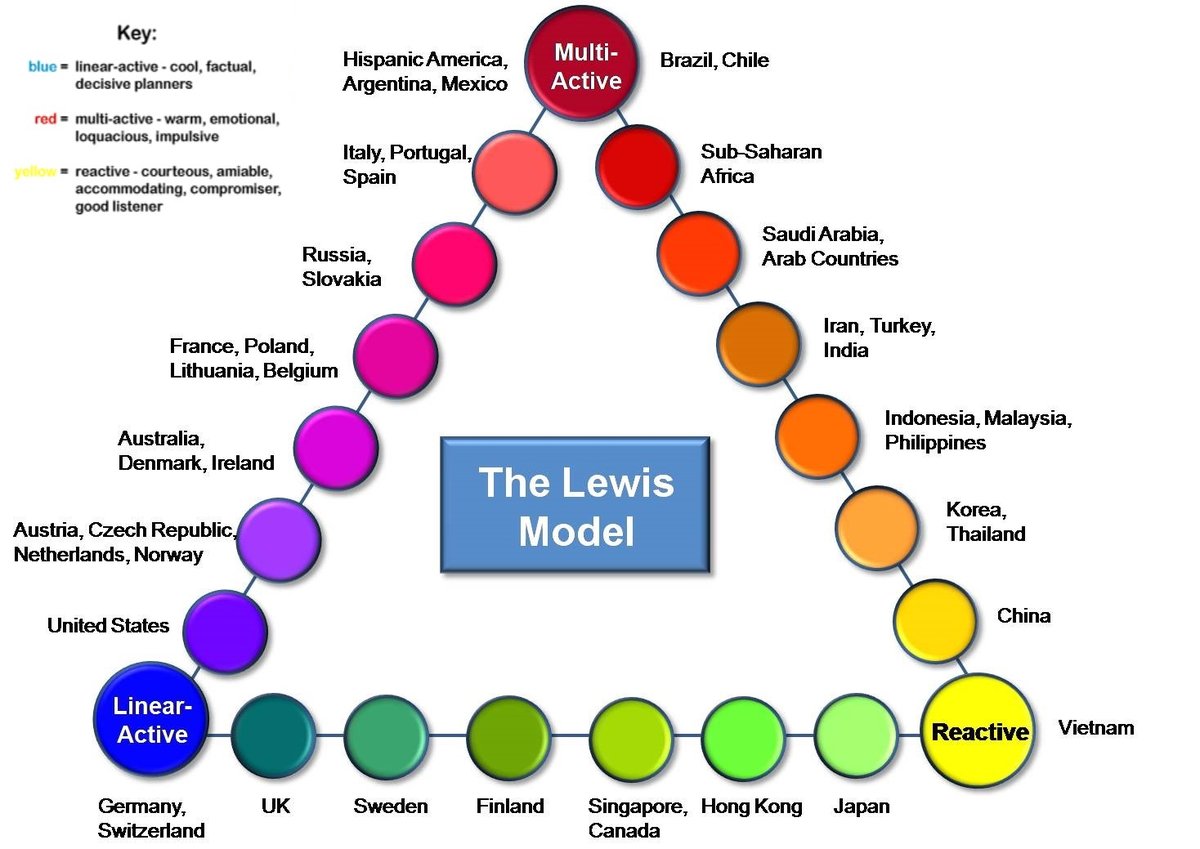
The model is sometimes shown with countries placed along a spectrum. This can be a useful introduction, but it is a broad generalisation: no country has a single communication style, and people’s behaviour varies with the individual, situation and workplace. The model is best used to help us ask questions—not to predict how a particular person will communicate.
When communication feels difficult, it may help to ask: Could we have different expectations about how this conversation should work? Checking those expectations can prevent a difference in style from becoming a misunderstanding.
Join the discussion
Have you experienced a communication breakdown that wasn’t really about language? What do you think was happening? We’d be interested to hear your experience in the comments on LinkedIn. On our website, you can join the discussion via our LinkedIn post.